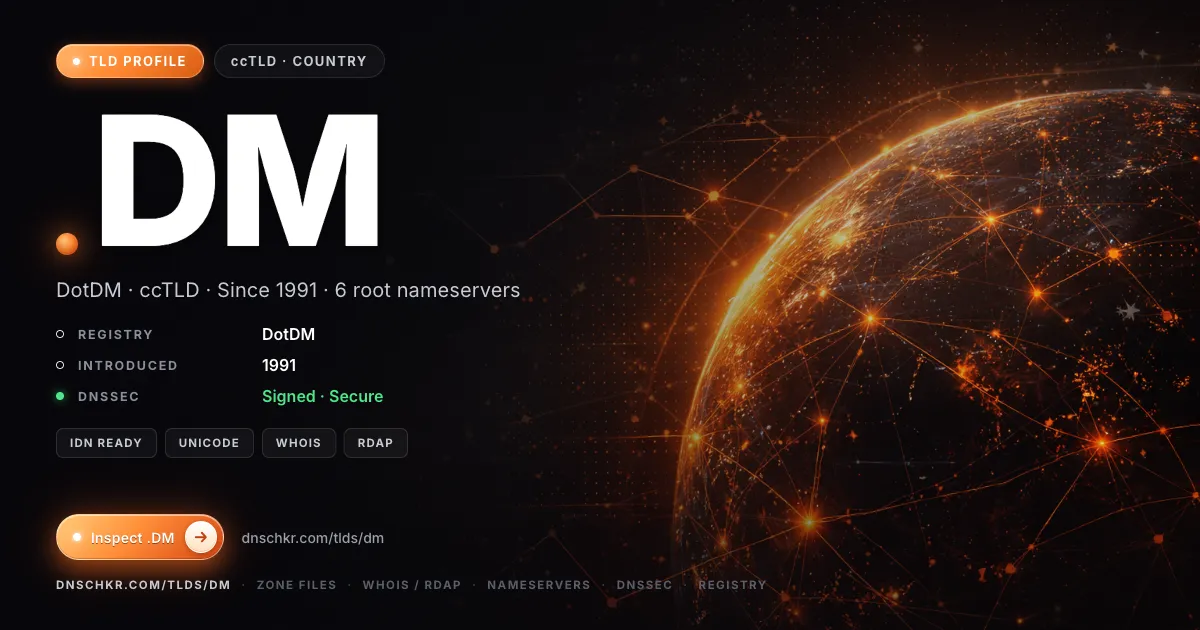
.dm ccTLD
The .dm top-level domain is the country-code domain for Dominica, a Caribbean nation. It is open for registration by individuals and organizations worldwide, with no residency requirements. The registry applies restrictions on certain names, particularly those related to banking, fintech, cryptocurrencies, and the word 'Dominica', to protect national interests and domain stability.
Registrations are open globally, but the registry may deny requests if a domain is potentially injurious to Dominica’s laws, morals, or cultural sensitivities. Domains related to banking, fintech, or cryptocurrencies are rejected. Names containing 'Dominica' require special approval. Second-level domains are allowed, but .com.dm, .net.dm, and .org.dm are brand-protected and not configurable in the DNS zone.
.dm Domain Overview
The .dm extension is a country-code top-level domain (ccTLD) in the Domain Name System (DNS). It is managed by DotDM Corporation. .dm was introduced in 1991.
Registration Info
Registration pricing for .dm is not publicly listed. Contact an ICANN-accredited registrar for availability and pricing.
Security Features
- DNSSEC
- CAA Record Support
What Is the History of .dm?
The .dm domain was delegated to DotDM Corporation in 1991 and is managed as the official country-code top-level domain for Dominica. A redelegation was confirmed by IANA in 2007, reaffirming DotDM's role as the registry operator. The domain is used by local businesses, international registrants, and government entities operating in or connected to Dominica.
Did you know?
The .dm TLD serves a specific purpose in the domain ecosystem, providing users with clear context about the websites using this extension.
What Is .dm Used For?
The .dm TLD is commonly used for the following purposes:
Local business websites
International registrants targeting the Caribbean
Government services
Educational institutions in Dominica
How Do I Register a .dm Domain?
Eligibility
No residency or local presence required. Registrations are open globally but subject to registry review. The registry may reject domains that are misleading, offensive, or related to prohibited sectors like banking or cryptocurrencies.
Open Registration
The .dm TLD is available for registration through accredited domain registrars.
Registration Process
- Choose an accredited domain registrar that offers .dm domains
- Check domain availability using the registrar's search tool
- Complete the registration process and provide required information
- Pay the registration fee (typically )
- Manage your domain settings through your registrar's control panel
.dm vs Related Domain Extensions
How does .dm compare to similar top-level domains? This comparison covers pricing, type, and availability to help choose the right domain extension.
View the full TLD Directory to browse all 1,900+ top-level domains with pricing, registration density analysis, and DNSSEC adoption rates.
Frequently Asked Questions
How Is This .dm Data Compiled?
DNS Checker maintains a comprehensive TLD directory covering all 1,900+ active top-level domains. The data on this page combines multiple authoritative sources to provide information not found in standard TLD listings.
Zone File Analysis
Domain registration counts and density analysis are computed daily from TLD zone files, providing accurate registration statistics rather than estimates.
DNSSEC Adoption Tracking
DNSSEC deployment percentages are measured by scanning actual DNS records across all registered domains in each TLD zone.
Registrar Price Monitoring
Registration, renewal, and transfer prices are checked hourly across multiple accredited registrars and compared automatically.
Provider Market Share
DNS provider distribution is calculated from nameserver records, showing which hosting providers serve the most domains in each TLD.
Use DNS Checker tools to inspect any .dm domain: run a full DNS health check, check DNS propagation, look up WHOIS records, or verify email authentication.
Disclaimer: The information on this page is sourced from IANA, ICANN, and respective registry operator publications, then structured and formatted with the assistance of AI. While accuracy is a priority, details such as pricing, registration requirements, and policies may change. Always verify with the official registry or an accredited registrar before making registration decisions.